

Newburgh has an unmarked spot of history, going back 700 years ago. In the year of 1298, in the month of June, Scotland’s greatest patriot, Sir William Wallace, the Guardian of Scotland, fresh from his victory at Stirling Bridge was forced to march his men across the country to prevent a pincer movement by one of Edward of England’s great army leaders, the Earl of Pembroke. The Earl of Pembroke had landed at Tayport on the Fife coast and was intent on cutting the Scottish Kingdom in half by taking Perth. The two opposing forces met, at what is now referred to as the Battle of Black Earnside, which is just
east of the Lindores Abbey and the Burgh of Newburgh. Four days they battled and with Wallace sorely pressed, he ordered Balfour of Denmiln to raise the Newburgh men to fight, as was his right as Guardian of the Realm. This they replied to immediately, Balfour himself, with many hundreds of Newburgh men still lie in the field of Black Earnside, but the day was saved for Scotland and Wallace returned victorious to Stirling.
In commemoration of this part of Scotland’s martial history that the Newburgh men and women played, acelebration, in the form of games are still held on the third weekend of June of each year, making Newburgh Games the oldest celebrated games in Scotland!
It was from the lands of Parkhill that the Monks quarried the stone for Lindores Abbey in Newburgh. They belonged at that time to David, Earl of Huntingdon and Angus. They passed from him into the hands of the Leslie family, Earls of Rothes, until in 1546 John Leslie forfeited them for taking part with his nephew in the plot to murder Cardinal Beaton. In 1575 however they were restored to him in “consideration of his repentance”.
To the west of Parkhill there stretched for several miles a wood known as Black Earn side, or as it was sometimes mis-spelt, Black Iron side. It was a dark wood which covered the hillside and extended down to the waters edge. The name of Earn Side favours the idea that geologists entertain, that the river Earn would its course by the foot of the Fife hills, and joined with the Tay near Longforgan.
Sir William Wallace in his fight against the English often used Black Earn side as a shelter and there is still a bridge along which the road passes near the top of the ascent, about two miles east from the Abbey which is known as ‘Wallace’s Brig’. In 1298 in the month of June, Wallace fought the Earl of Pembroke at Black Earn Side.
“This wood we’ll hold as long as we stand,
To the last man we’ll fight it, sword in hand.
The right is ours, let’s do it manfully;
I’ll free this land once more before I die.”

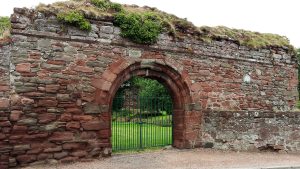
Although the Scots wereheavily out numbered they built a stockade and held the English at bay. Help came from Newburgh and the villages roundabout in the shape of labourers with farming tools until finally the English were completely routed and overthrown. Wallace and his triumphant followers retired to the Abbey, there to recuperate and celebrate their success, entering through the Slype, the Eastern entrance to the cloisters which is still standing today.
The mill that stands today by Parkhill farmyard is probably built on or near the site of a more ancient mill built by the Abbey monks. There were six mills that stood along the burn, that ran from the Abbey to Loch Lindores. This burn was known as Priestsburn at the southern end and Mill burn as it passed Parkhill on its way to the loch. One of these mills is Glenbirnie which was a sawmill, and behind it part of an ancient aqueduct may be seen.
